

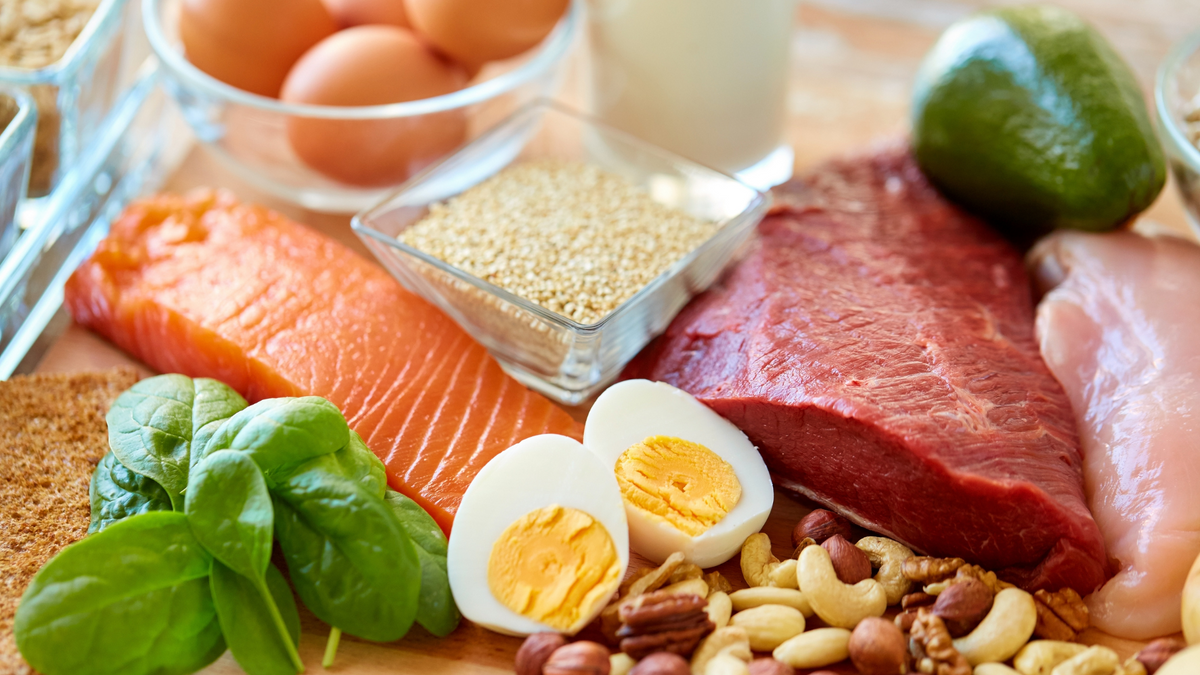
Short answer: Leucine is the amino acid that tells your muscles to start rebuilding. Around surgery, aim for close to 3 g of leucine at each main meal. Research in adults over 60 puts the trigger at about 2.8 g, which comes with roughly 30 g of good-quality protein (6). Leucine works as part of enough total protein, not on its own.
This guide covers why leucine matters after an operation, how much you need per meal and per day, which foods and shakes get you there, and what you can realistically expect in the weeks after you start.
What is leucine?
Leucine is one of the nine essential amino acids. Your body cannot make it, so it has to come from food. It is also one of the three branched-chain amino acids (BCAAs), along with isoleucine and valine.
What sets leucine apart is its role as a signal. It switches on a pathway inside muscle cells called mTOR, which starts muscle protein synthesis, the process your body uses to repair and build muscle (6). Think of the other amino acids as the bricks and leucine as the foreman who tells the crew to start work. Without enough bricks, the foreman cannot build much, which is why leucine and total protein go together.
Why leucine matters more around surgery
Surgery, pain and time spent in bed or in a sling all push your body toward breaking muscle down. The loss can be fast. In a knee replacement trial, people taking a placebo lost 14.3% of their thigh muscle volume in the first 2 weeks and 18.4% by 6 weeks (1). Thigh muscle is what gets you out of a chair, up stairs and through physical therapy.
Two things make protein harder to use well at this time:
- Appetite drops. Nausea, pain medicine and stress make it hard to eat full meals, so each bite of protein has to count.
- Age blunts the signal. Older muscle responds less to small amounts of protein. In one analysis, older men needed about 0.40 g of protein per kg of body weight in a meal to get the full muscle-building response, compared with 0.24 g per kg in young men (7). For a 70 kg (154 lb) person that is 70 x 0.40 = 28 g of protein for an older adult, versus 70 x 0.24 = about 17 g for a young one.
Leucine is part of the reason. When older adults were given a small dose of essential amino acids, muscle building only rose when the mix was richer in leucine (41% instead of 26%) (8).
How much leucine do you need per meal?
Researchers talk about a "leucine threshold," a minimum amount per meal that switches muscle building on. A 2024 review put it at 2.8 g or more of leucine per meal for adults over 60, which comes with about 30 g of protein (6). Adults under 30 did not show a clear cutoff; their response rose steadily with the protein in the meal.
Be aware that the threshold is a useful rule of thumb, not a hard line. A 2023 systematic review found that the leucine dose predicted the muscle-building response in older adults but could not pin down one exact threshold (9). In practice, a few grams either way matters less than eating a solid portion of protein at every meal.
Spreading protein out also helps. In a small feeding study, eating about 30 g of protein at each of three meals switched on muscle building about 25% more over a day than eating most of it at dinner (21).
How much leucine per day, and how much is too much?
No official leucine target exists for surgery patients. Here is how the numbers stack up for a 70 kg adult:
| Benchmark | Per kg of body weight, per day | For a 70 kg adult | Source |
|---|---|---|---|
| Estimated Average Requirement (the starting dose in a leucine safety study) | 50 mg | 70 x 0.05 = 3.5 g a day | 16 |
| Three meals at the 2.8 g threshold | Not weight based | 3 x 2.8 = 8.4 g a day | 6 |
| Cautious upper limit (older men) | 351 mg | 70 x 0.351 = about 24.5 g a day | 15 |
| Suggested upper limit (healthy men) | 500 mg | 70 x 0.5 = 35 g a day | 15 |
A food-first plan sits comfortably between the requirement and the upper limits. In older men, blood ammonia rose above normal only at intakes above 550 mg per kg a day (15), and in young men the rise started above 500 mg per kg a day (16). Both are far more than food and a daily shake provide.
Leucine rides along with your total protein, so set that target first. European surgical nutrition guidelines (ESPEN) estimate about 1.5 g of protein per kg of ideal body weight a day around surgery (13). At 70 kg that is 70 x 1.5 = 105 g a day. For adults over 65 who are recovering from illness, an expert group suggests 1.2 to 1.5 g per kg (14). Our guide to what to eat after surgery turns those numbers into real meals.
Leucine in common foods
Animal foods and dairy are the richest sources. The values below are calculated from USDA FoodData Central figures per 100 g, scaled to the serving shown (18). For example, chicken has 2.33 g of leucine per 100 g, so 85 g gives 2.33 x 0.85 = 1.98 g.
| Food (USDA entry) | Serving | Protein | Leucine |
|---|---|---|---|
| Chicken breast, roasted | 85 g (3 oz) | 26.4 g | 1.98 g |
| Ground beef 85% lean, cooked | 85 g (3 oz) | 23.6 g | 1.84 g |
| Light tuna, canned in water | 85 g (3 oz) | 21.7 g | 1.76 g |
| Firm tofu | 126 g (about 1/2 cup) | 21.8 g | 1.75 g |
| Greek yogurt, plain nonfat | 170 g (6 oz cup) | 16.2 g | 1.61 g |
| Lentils, boiled | 198 g (about 1 cup) | 17.9 g | 1.29 g |
| Cottage cheese, 2% | 113 g (about 1/2 cup) | 11.8 g | 1.19 g |
| Eggs, hard-boiled | 100 g (about 2 large) | 12.6 g | 1.08 g |
| Milk, 2% | 244 g (about 1 cup) | 8.1 g | 0.76 g |
| Quinoa, cooked | 185 g (about 1 cup) | 8.1 g | 0.48 g |
| Peanuts, dry-roasted | 28 g (1 oz) | 6.8 g | 0.43 g |
| OptiFuel packet (label) | 1 packet | 25 g | 3 g |
Two things stand out. First, a single 3 oz serving of chicken gives about 2 g of leucine, not the 2.8 g an older adult may need. To get there from chicken alone you would need about 2.8 / 2.33 x 100 = 120 g, roughly 4 oz. Second, combining foods works: 3 oz of chicken plus a 6 oz cup of Greek yogurt adds up to 1.98 + 1.61 = 3.59 g.
Plant-based eaters can get there too, with planning. Plant protein isolates range widely in leucine, from 5.1% of the protein in hemp to 13.5% in corn, compared with 9.0% in milk protein. Several also carry fewer essential amino acids overall: about 21% to 22% of the protein in oat, lupin and wheat, versus 39% in milk protein (17). The same researchers note that mixing plant proteins, or blending plant and animal proteins, brings the profile closer to animal protein.
How much leucine should be in a protein powder?
If a shake is filling a gap on days you cannot eat much, check the label for these points:
- Leucine listed, close to 3 g per serving. That lines up with the 2.8 g per-meal figure above (6). If leucine is not listed, you can estimate it: milk protein is about 9.0% leucine (17), so 25 g of milk protein gives roughly 25 x 0.09 = 2.25 g.
- Leucine content, not just protein grams. In older women, twice-daily 15 g protein drinks with 4.2 g of leucine drove more muscle building than drinks with the same protein and 1.3 g of leucine (10). Those drinks came on top of a diet with 1.0 g of protein per kg a day, so they added to meals rather than replacing them.
- Third-party testing, such as Informed Sport, so you know the label matches what is inside.
- Texture you can actually finish. In the first days after surgery, a thin shake you can sip through a straw beats a thick one that sits half full.
- Your health conditions. Check sugar if you have diabetes and milk content if you have a dairy allergy.
Leucine pills or BCAAs instead of protein?
For most people, a complete protein is the better bet. When healthy older men took 2.5 g of leucine with each meal for 3 months, they gained no muscle and no strength (11). In a bed rest study, extra leucine helped people keep more leg strength over 2 weeks, but their lean mass loss was about the same by the end (12). A whole protein food or shake brings leucine plus every other amino acid your muscles need to actually build. Our roundup of the best supplements for surgery recovery covers where amino acids fit next to vitamin C, vitamin D, omega-3s and creatine.
What to expect after you start: a realistic timeline
You will not feel leucine working. What you can track is whether each meal hits its protein target, and later, how your legs or arms hold up in therapy. Here is what research shows at each stage. None of these studies tested a Thrive product, and results vary from person to person. Your surgical team's instructions come first.
About 1 week before surgery
Start building the habit: 25 to 30 g of protein at breakfast, lunch and dinner. If you use a shake, add it between meals so it adds to food instead of replacing it. The two knee replacement trials that found less thigh muscle loss both started amino acids about 1 week before surgery and continued 2 weeks after, using 20 g twice a day in one and 9 g a day in the other (1, 3). If your date is closer, start as soon as you can.
The night before
This step is about carbohydrate, not protein. If your anesthesia team approves, a clear carbohydrate drink at bedtime replaces part of the long overnight fast. In a trial that used a carbohydrate drink the evening before and the morning of surgery, people felt less hungry and less anxious while they waited than people who fasted (20). Follow your fasting rules exactly, and ask first if you have diabetes. Our carb loading drink guide explains timing.
Days 1 to 7 after surgery
Expect a small appetite. Restart your protein as soon as you are eating again, and lean on soft foods and shakes. This is when muscle loss is fastest: in one knee replacement trial, thigh muscle volume fell 3.4% in 2 weeks with essential amino acids versus 14.3% with placebo (1). Protein is not a shield against lying still, though. In older men with one leg in a cast for 5 days, extra protein did not reduce the muscle they lost (22). Getting up and moving as your team allows is part of the plan.
Weeks 2 to 6
Physical therapy picks up, and protein works best alongside it. In a small hip fracture study, people who drank about 32 g of whey protein around their rehab sessions gained more leg strength over 2 weeks than those who did rehab alone (19). In a 60-person knee replacement trial, patients taking amino acids from a week before to 2 weeks after surgery kept more front-thigh muscle over the first month and got back to everyday tasks sooner (3). To be fair, a second knee trial found less muscle loss at 6 weeks but similar strength and mobility test results (2). Muscle size is the clearest benefit, and how you feel day to day may not change much.
After 6 weeks
This is the rebuilding phase, and steady protein at every meal still matters. Two years after knee replacement, people who had taken amino acids around surgery had more thigh muscle and strength than the placebo group, though their pain and knee function scores were similar (4). A 2025 review of 10 orthopedic trials found amino acids protected muscle in some studies but not all, and the best dose and timing are still being worked out (5). For procedure-specific advice, see supplements after knee replacement surgery.
Who should check with their doctor first
- Kidney disease. People with severe kidney disease who are not on dialysis may need to limit protein (14).
- Diabetes. Ask before using any pre-surgery carbohydrate drink, and watch the sugar in shakes.
- Milk allergy. Whey and milk protein shakes are not suitable.
- Bariatric, bowel or special diets. Your team may set a specific protein and texture plan.
- Blood thinners. Show your surgeon the label of any supplement that contains fish oil or turmeric.
Where Thrive Protocol fits
Each OptiFuel packet gives 25 g of protein (whey plus collagen) and 3 g of leucine, along with vitamin C, vitamin D, omega-3s and turmeric extract. It is made in the USA, Informed Sport tested, and thin enough to drink through a straw. Take one packet a day between meals, mixed with 12 to 16 oz of water, milk or non-dairy milk. No trial has tested OptiFuel itself, and the amino acid studies above used different products and doses, so treat it as an easy way to hit your protein, not a shortcut to the study results.
- Surgery still ahead: the Surgical Protocol Kit ($299.99 for 4 weeks) pairs daily OptiFuel with 2 OptiCharge carbohydrate packets for bedtime the night before surgery. Start OptiFuel about 1 week before.
- Surgery already done: the Recovery Protocol Kit ($289 for 4 weeks) is the same OptiFuel without OptiCharge.
- Add-on: the Recovery and Strength Mix ($49.99) is the only Thrive product with creatine and arginine. Thrive suggests taking it daily alongside either kit. In healthy adults whose leg had been in a cast, creatine combined with strength training supported a faster regain of thigh muscle size and power during rehab (23), although a trial around knee replacement found no added benefit in the first month (24).
Thrive's guidance is that there is no need to stop OptiFuel before surgery because the amounts of fish oil and turmeric are low, but your surgeon's instructions always come first.
Thrive Protocol kits are HSA/FSA eligible, so you can use pre-tax health dollars.
These statements have not been evaluated by the Food and Drug Administration. This product is not intended to diagnose, treat, cure, or prevent any disease.
Frequently asked questions
How much leucine do I need per day after surgery?
There is no surgery-specific target. Aim for close to 3 g at each main meal; in adults over 60 the research figure is about 2.8 g, which comes with roughly 30 g of protein (6). At 2.8 g per meal, three meals give 3 x 2.8 = 8.4 g a day, well above the average requirement and well below the upper limits found in safety research (15, 16).
How much leucine should be in a protein powder?
Close to 3 g per serving is a sensible target, paired with 25 to 30 g of total protein (6). If the label does not list leucine, milk protein is about 9% leucine (17), so 25 g of protein gives roughly 2.25 g.
Should I take a leucine or BCAA supplement instead of a protein shake?
Usually not. Leucine on its own did not build muscle in healthy older men over 3 months (11). A complete protein gives you leucine plus the other amino acids muscle is made from.
When should I start eating more leucine before surgery?
About 1 week before surgery is a practical start. The knee replacement trials that saw less muscle loss began amino acids about a week ahead and continued for 2 weeks after (1, 3). Keep going through rehab.
Can you take too much leucine?
From food and a daily shake, this is very unlikely. Safety studies suggest an upper limit of about 500 mg per kg a day, roughly 35 g for a 70 kg adult, with a cautious figure of about 24.5 g for older men (15). People with kidney disease should ask their doctor about total protein.
Can I get enough leucine on a vegetarian or vegan diet?
Yes, with larger portions and some mixing. Firm tofu gives about 1.75 g of leucine in a half cup, and pairing plant proteins brings their profile closer to animal protein (17).
Keep reading
- Pre-surgery nutrition: the 2 to 4 weeks before surgery
- Preparing for orthopedic surgery
- How to prepare your home for orthopedic surgery recovery
- Top recovery tips for faster healing
- Protecting muscle after joint replacement
Getting ready for surgery? See what is inside the Surgical Protocol Kit, built to cover the weeks before and after a procedure.
References
- Dreyer HC, et al. Essential amino acid supplementation in patients following total knee arthroplasty. J Clin Invest. 2013;123(11):4654-4666. PubMed 24135139
- Dreyer HC, et al. Essential amino acid supplementation mitigates muscle atrophy after total knee arthroplasty. JB JS Open Access. 2018;3(2):e0006. PubMed 30280129
- Ueyama H, et al. Perioperative essential amino acid supplementation suppresses rectus femoris muscle atrophy and accelerates early functional recovery following total knee arthroplasty. Bone Joint J. 2020;102-B(6 Supple A):10-18. PubMed 32475274
- Ueyama H, et al. Perioperative essential amino acid supplementation facilitates quadriceps muscle strength and volume recovery after TKA. J Bone Joint Surg Am. 2023;105(5):345-353. PubMed 36856692
- Brown E, et al. Amino acid supplementation may help prevent muscle wasting after orthopedic surgery, but additional studies are warranted: a systematic review. HSS J. 2025;21(2):200-210. PubMed 39802328
- Layman DK. Impacts of protein quantity and distribution on body composition. Front Nutr. 2024;11:1388986. PubMed 38765819
- Moore DR, et al. Protein ingestion to stimulate myofibrillar protein synthesis requires greater relative protein intakes in healthy older versus younger men. J Gerontol A Biol Sci Med Sci. 2015;70(1):57-62. PubMed 25056502
- Katsanos CS, et al. A high proportion of leucine is required for optimal stimulation of the rate of muscle protein synthesis by essential amino acids in the elderly. Am J Physiol Endocrinol Metab. 2006;291(2):E381-7. PubMed 16507602
- Wilkinson K, et al. Association of postprandial postexercise muscle protein synthesis rates with dietary leucine: a systematic review. Physiol Rep. 2023;11(15):e15775. PubMed 37537134
- Devries MC, et al. Protein leucine content is a determinant of shorter- and longer-term muscle protein synthetic responses in healthy older women. Am J Clin Nutr. 2018;107(2):217-226. PubMed 29529146
- Verhoeven S, et al. Long-term leucine supplementation does not increase muscle mass or strength in healthy elderly men. Am J Clin Nutr. 2009;89(5):1468-75. PubMed 19321567
- English KL, et al. Leucine partially protects muscle mass and function during bed rest in middle-aged adults. Am J Clin Nutr. 2016;103(2):465-73. PubMed 26718415
- Weimann A, et al. ESPEN guideline: Clinical nutrition in surgery. Clin Nutr. 2017;36(3):623-650. PubMed 28385477
- Bauer J, et al. Evidence-based recommendations for optimal dietary protein intake in older people: a position paper from the PROT-AGE Study Group. J Am Med Dir Assoc. 2013;14(8):542-59. PubMed 23867520
- Elango R, Rasmussen B, Madden K. Safety and tolerability of leucine supplementation in elderly men. J Nutr. 2016;146(12):2630S-2634S. PubMed 27934655
- Pencharz PB, Elango R, Ball RO. Determination of the tolerable upper intake level of leucine in adult men. J Nutr. 2012;142(12):2220S-2224S. PubMed 23077191
- Gorissen SHM, et al. Protein content and amino acid composition of commercially available plant-based protein isolates. Amino Acids. 2018;50(12):1685-1695. PubMed 30167963
- U.S. Department of Agriculture, Agricultural Research Service. FoodData Central (SR Legacy). fdc.nal.usda.gov. Food values accessed 21 October 2026.
- Niitsu M, et al. Effects of combination of whey protein intake and rehabilitation on muscle strength and daily movements in patients with hip fracture in the early postoperative period. Clin Nutr. 2016;35(4):943-9. PubMed 26216195
- Hausel J, et al. A carbohydrate-rich drink reduces preoperative discomfort in elective surgery patients. Anesth Analg. 2001;93(5):1344-50. PubMed 11682427
- Mamerow MM, et al. Dietary protein distribution positively influences 24-h muscle protein synthesis in healthy adults. J Nutr. 2014;144(6):876-80. PubMed 24477298
- Dirks ML, et al. Skeletal muscle disuse atrophy is not attenuated by dietary protein supplementation in healthy older men. J Nutr. 2014;144(8):1196-203. PubMed 24919692
- Hespel P, et al. Oral creatine supplementation facilitates the rehabilitation of disuse atrophy and alters the expression of muscle myogenic factors in humans. J Physiol. 2001;536(Pt 2):625-33. PubMed 11600695
- Roy BD, et al. Creatine monohydrate supplementation does not improve functional recovery after total knee arthroplasty. Arch Phys Med Rehabil. 2005;86(7):1293-8. PubMed 16003653
This article is for education and does not replace advice from your surgeon or care team. Food values are from USDA FoodData Central (18); OptiFuel values are from the product label.
Prepare Your Home for Orthopedic Surgery Recovery