

Short answer: After rotator cuff surgery, eat protein at every meal (about 25 to 30 grams), plenty of fruit and vegetables for vitamin C, and foods with vitamin D and omega-3 fats, while drinking enough water to stay ahead of pain-medicine constipation. For the first few weeks, plan meals you can eat with one hand, because your arm will be in a sling. Skip alcohol and don't smoke.
The repaired tendon heals slowly, over months, and you'll spend a lot of that time with one working arm. Here's what to eat, and how to make eating easy while you recover.
Why food matters after a rotator cuff repair
In a rotator cuff repair, the surgeon reattaches tendon to bone. That connection takes weeks to knit and months to get strong, which is why your surgeon protects it with a sling and a careful rehab plan. Your body builds that repair from what you eat, especially protein, and it needs vitamin C to make collagen.
Many rotator cuff patients are over 50, and at that age muscle responds less to protein and shrinks faster when it isn't used. Meanwhile the shoulder muscles are resting in a sling and your appetite may be poor for a week or two. Put those together and it's easy to fall short on protein just when you need it most.
The research on food and rotator cuff healing specifically is still small. One 2023 study followed 55 patients after repair and found that those who regularly ate meat and fruit tended to regain shoulder function faster. It was observational, so it can't prove cause and effect, but it fits the broader surgical nutrition guidance: enough protein, enough calories, plenty of produce.
The key nutrients, in plain terms
- Protein. Surgical nutrition guidelines suggest at least 1.2 to 1.5 grams per kilogram of body weight a day. For an 80 kg (176 lb) adult, 80 x 1.5 = 120 g a day, or about 30 g at each of four meals and snacks.
- Vitamin C. Needed to make collagen, the main building block of tendon. Oranges, kiwi, strawberries, bell peppers and broccoli are all good sources. A supplement may help the repair heal: in a randomized study of 98 patients, the tendon failed to heal in 11% of those who took 500 mg of vitamin C a day for 45 days after surgery, compared with 23% of those who took none. The study was small, so the gap is promising rather than proven. Ask your surgeon what dose suits you.
- Vitamin D. Low vitamin D is linked with repairs that fail to heal. In a study of 982 patients, 5.9% of those who were deficient (below 20 ng/mL) around the time of surgery needed a second operation on the same shoulder, compared with 3.7% of those with normal levels. Low vitamin D has also been linked with more fatty change in the rotator cuff muscles. Ask your surgeon to check your level before surgery and whether a supplement makes sense for you.
- Omega-3 fats. Found in salmon, sardines, trout, walnuts and ground flaxseed. They're a normal part of a healthy diet.
- Fiber and fluids. Opioid pain medicine slows your gut. Prunes, oats, berries and lots of water help.
Week-by-week eating plan after rotator cuff surgery
| Time after surgery | What's happening | What to eat |
|---|---|---|
| Days 1 to 2 | Nerve block wearing off, possible nausea, sleeping upright | Bland and gentle: broth, crackers, toast, applesauce, yogurt, scrambled eggs. Sip water often. |
| Weeks 1 to 2 | Sling on, one-handed everything, pain medicine | One-handed meals with 25 to 30 g of protein each. Prunes and fiber daily. No alcohol while on pain medicine. |
| Weeks 3 to 6 | Still in the sling, passive motion with your therapist | Keep protein steady at 4 feedings a day, including a bedtime snack like Greek yogurt or cottage cheese. Fish twice a week. |
| Weeks 6 to 12 | Sling off, active motion begins | Normal balanced meals. Have protein within a couple of hours after PT sessions. |
| Months 3 to 6 | Strengthening | Protein spread through the day, enough total calories for your workouts, and fruit and vegetables at most meals. |
Easy one-handed foods for the sling weeks
This is the part nobody warns you about. Cutting meat, opening jars and peeling fruit all get hard with one arm. Set yourself up before surgery:
- Pre-cut rotisserie chicken or chicken strips
- Hard-boiled eggs, peeled ahead of time
- Single-serve Greek yogurt and cottage cheese cups (ask someone to loosen the lids)
- Ready-to-drink protein shakes, or protein packets you can shake in a bottle
- Soups in microwave-safe mugs you can sip
- Wraps, sandwiches and quesadillas cut into small pieces
- Pre-cut fruit, clementines, bananas and berries
- Frozen meals with a solid protein count, 20 grams or more
- Canned salmon or tuna in easy-open pouches
Our post on preparing your home for orthopedic surgery recovery has more one-handed setup tips.
Grocery list for your first two weeks
- Protein: eggs, Greek yogurt, cottage cheese, milk, rotisserie chicken, deli turkey, tuna or salmon pouches, tofu, protein shakes
- Produce: oranges, kiwi, strawberries, bananas, pre-cut melon, baby carrots, snap peas, bagged salad, frozen broccoli
- Grains: oatmeal cups, whole grain bread, tortillas, microwave rice pouches, crackers
- Healthy fats: walnuts, peanut butter, avocado cups, olive oil
- For your gut: prunes or prune juice, a high-fiber cereal, plenty of water
What to avoid after rotator cuff surgery
- Alcohol, especially with pain medicine or sleeping pills. It also disrupts sleep, which is already rough in a sling.
- Smoking and nicotine. A 2026 review of ten studies found smokers had roughly a 50% higher risk of the repair failing on follow-up imaging. If you smoke, ask your surgeon for help quitting.
- Skipping meals because it's a hassle to cook one-handed. Stock up on easy options instead.
- New supplements without checking. Some can affect bleeding or interact with your medicines.
Sleep matters too. Many patients sleep in a recliner for the first few weeks. Our post on sleep and recovery and the Shoulder Sleeper Pillow can help with that part. If you're wondering about getting back to your job, read when can I work again after shoulder surgery.
Where a surgical nutrition kit fits
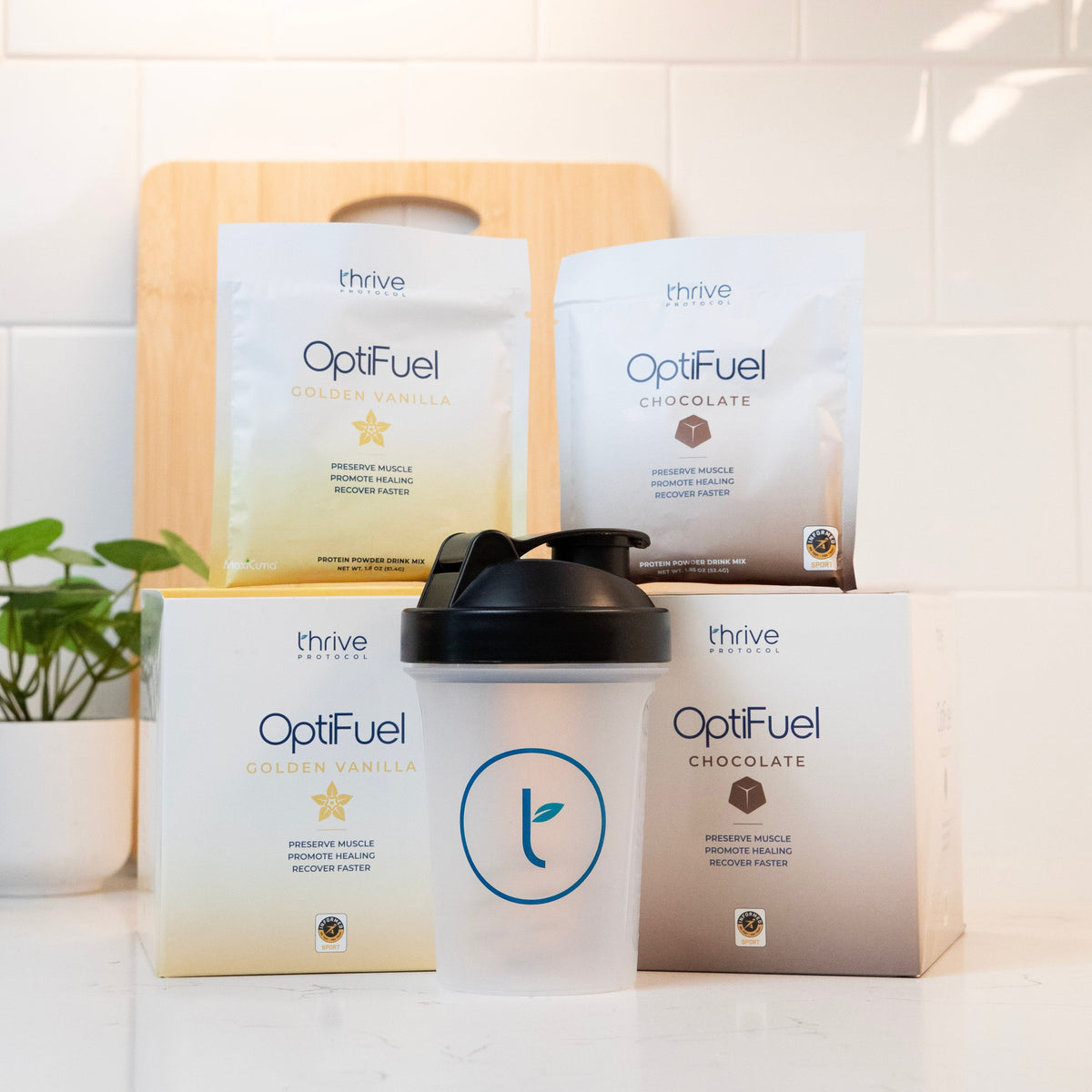
A quick disclosure: Thrive Protocol was founded by surgeons, including shoulder surgeons, and this is Thrive's blog. Food is the foundation. Our kits are there for the weeks when making a high-protein meal one-handed isn't realistic. One OptiFuel packet a day gives you 25 grams of whey protein and 3 grams of leucine, plus collagen, omega-3s, curcumin and vitamins, and it mixes in a shaker with one hand. It's designed to help you meet your protein needs and support muscle maintenance during recovery. If your surgery is coming up, the Surgical Protocol Kit starts about a week before and adds OptiCharge for the night before. If you've already had your repair, the Recovery Protocol Kit is the same OptiFuel without OptiCharge. Both are Informed Sport tested, made in the USA and HSA/FSA eligible. Check with your surgeon before starting.
These statements have not been evaluated by the Food and Drug Administration. This product is not intended to diagnose, treat, cure, or prevent any disease.
Get the free Surgery Recovery Guide
Our free Surgery Recovery Guide puts eating, hydration, movement and sleep for the weeks after surgery on one page. Download it and hand a copy to whoever is helping you at home.
If you'd like help covering protein during the sling weeks, see the Recovery Protocol Kit, and use code THRIVE10 for 10% off your order. For the bigger picture on shoulder recovery nutrition, read our shoulder surgery nutrition guide.
Frequently asked questions
What is the best food to eat after rotator cuff surgery?
There isn't one best food. What helps is steady protein at every meal from eggs, dairy, chicken, fish or tofu, plus fruit and vegetables rich in vitamin C, like oranges, kiwi and peppers. Add fish or walnuts for omega-3s and drink plenty of water.
How much protein do I need after rotator cuff surgery?
Surgical nutrition guidelines suggest at least 1.2 to 1.5 grams per kilogram of body weight a day. For an 80 kg adult that's roughly 96 to 120 grams, spread over four meals and snacks. If you have kidney disease, ask your doctor for your own target.
What should I eat the first few days after shoulder surgery?
Start with bland, easy food like broth, toast, crackers, yogurt, applesauce and scrambled eggs, especially if the anesthesia or nerve block leaves you queasy. Move back to regular meals with protein as soon as your stomach settles.
How can I eat with one arm in a sling?
Prep before surgery. Buy pre-cut chicken and fruit, single-serve yogurt, soups you can sip from a mug, and ready-to-drink protein shakes. Ask someone to loosen lids and cut food into bite-size pieces for the first couple of weeks.
Can I drink alcohol after rotator cuff surgery?
Avoid it while you're taking pain medicine or sleep aids, since the combination can be dangerous. Alcohol also disrupts sleep and recovery. Ask your surgeon when it's reasonable to have a drink again.
References
- Cancienne JM, Brockmeier SF, Kew ME, Werner BC. Perioperative Serum 25-Hydroxyvitamin D Levels Affect Revision Surgery Rates After Arthroscopic Rotator Cuff Repair. Arthroscopy. 2019;35(3):763-769.
- Martel M, Laumonerie P, Girard M, et al. Does vitamin C supplementation improve rotator cuff healing? A preliminary study. Eur J Orthop Surg Traumatol. 2022;32(1):63-70.
- Liu J, Wang W, Wang Z, et al. The Association between Dietary Habits and Rapid Postoperative Recovery of Rotator Cuff Repair. Nutrients. 2023;15(21):4587.
- Oh JH, Kim SH, Kim JH, et al. The level of vitamin D in the serum correlates with fatty degeneration of the muscles of the rotator cuff. J Bone Joint Surg Br. 2009;91(12):1587-1593.
- Weimann A, Braga M, Carli F, et al. ESPEN guideline: Clinical nutrition in surgery. Clin Nutr. 2017;36(3):623-650.
- Wischmeyer PE, Carli F, Evans DC, et al. American Society for Enhanced Recovery and Perioperative Quality Initiative Joint Consensus Statement on Nutrition Screening and Therapy Within a Surgical Enhanced Recovery Pathway. Anesth Analg. 2018;126(6):1883-1895.
- Wall BT, Dirks ML, Snijders T, et al. Substantial skeletal muscle loss occurs during only 5 days of disuse. Acta Physiol (Oxf). 2014;210(3):600-611.
- Nguyen VT, Kuo YJ, Wu LC, et al. Impact of smoking on structural failure after arthroscopic rotator cuff repair: a systematic review and meta-analysis. J Shoulder Elbow Surg. 2026;35(10):e958-e969.
- Mamerow MM, Mettler JA, English KL, et al. Dietary protein distribution positively influences 24-h muscle protein synthesis in healthy adults. J Nutr. 2014;144(6):876-880.
This article is general education, not medical advice. Talk to your surgeon or physical therapist about your own recovery plan.
What to Eat After ACL Surgery